Sunday, 13 November 2016

Conventional Compressed, Film Coated Tablet Formulation Development


In addition to the active ingredient, tablet normally consist of the following excipients.
  •     Diluent / Filler
  •     Binder
  •     Disintegrant
  •     Lubricnt
  •     Glidant
There must be a harmony between the concentrations of these excipients to manufacture a tablet that comply with the quality parameters.
Given below is a suitable range for the quantity of these materials that I determined by my own experience.

Binder .......................... 3 - 5%
Disintegrant ................. Double than the quantity of the binder
Lubricant + Glidant ….... Not more than 1% of the total weight
Diluent ......................... To make up the required weight

*Note: This range of quantities is not applicable for every tablet formulation.

In order to develop a smooth compact table, a 20-30% portion of the formulation is sieved (normally through sieve no.40) into a fine powder. eventual mixing of this fine powder with the granules result into filling of the of void spaces that develop between the granules and result into a smooth surface of the tablet.
In the conventional wet and dry granulation methods, all the ingredients, except the lubricant and the glidant, are sieved and mixed before the preparation of granules. In the wet granulation method a liquid solution of the binding agent is applied while in the dry granulation, rotary compaction or slugging is normally utilized for the preparation of the grains.
After granulation, the glidants and lubricants are sieved and mixed with the grains. Finally the grains are subjected to the compression.
It is advisable to divide the disintegrant into two halves. One portion is integrated within the granules before granulation while the other is added after the granulation before the compression of the tablets. As a result the disintegrant not only break the tablet but also force the disintegration of the grains.

*Note: For information about the troubleshooting of the common issues that are encountered during compression read the following posts.


Film coating of the tablet normally consist of the following excipients.

  • Polymer
  • Plasticizer
  • Polishing agent
  • Opaquant
  • Colorant
  • Solvent
  • Miscellaneous: Flavors, antioxidants, antimicrobials etc.
The coating usually constitute 3-4% of the tablet weight. Therefore, the coating formulation is adjusted in such a way that all the ingredients of the formulation, collectively make up the weight that is equivalent to 3-4% of the total tablet weight.
For example, lets say we are supposed to coat a batch of 50 Kg. We calculate 4% of the batch i.e 
50 x 4% = 2 Kg. Therefore, the solid mass of the coating formulation must not be greater than 2 Kg.
Based on my experience the following quantities of the coating agents has proved to be suitable in most of the cases.

Polymer……………….approx. 50%
Plasticizer……………. half the concentration of the polymer
Polishing agent……. 1%
Opaquant..................... 1%
Colorant………………. 1%
Miscellaneous........... Rest of the formulation

*Note: These quantities are not suitable for all formulation. An adjustment in these quantities is made based on the outcome of the results.

In our present case, as the total solid content of the coating formulation is 2 Kg, we can calculate the individual quantities of the excipients as given below.

Polymer………………. 2 Kg x 50% = 1 Kg
Plasticizer……………. 2 Kg x 25% = 0.5 Kg
Polishing agent……. 2 Kg x 1% = 0.02 Kg
Opaquant..................... 2 Kg x 1% = 0.02 Kg
Colorant………………. 2 Kg x 1% = 0.02 Kg
Miscellaneous........... 2 Kg x 22% = 0.44 Kg
                                           Total = 2 Kg

The quantity of the solvent depends on the choice of the solvent. If an organic solvent is utilized in the formulation, normally a 5% coating solution is formed. In case of an aqueous solution, normally 10-15% solution is used.
Lets say we have to prepare a 12% aqueous coating solution for 2 Kg of the solid coating material.
In order to prepare a 12% coating solution,
2000 X 100 ÷ 12 = approx. 16 Liters
So, 2 Kg of the solid content, dissolved in 16 Liters of water, will give a 12% coating solution.

Monday, 5 September 2016

Troubleshooting for the Hardness, Friability and sticking during the compression of Tablets

Issues that are related to the hardness and friability of the tablets are frequently encountered during compression. The wise approach to resolve these problems is to start with the simplest solution before considering the complex, time consuming fixes.
Compression force of the Rotary tablet press machine can easily be controlled by adjusting the speed of its rotation. Slow speed of rotation provide more force of compaction and vice versa. Performing a fine tuning of the rotation speed is one of the simplest solution for adjusting the hardness of the tablets.
Moisture content, on the other hand, also affect the hardness by creating a binding force between the granules. Increasing the moisture in the granules can also increase the hardness but elevated moisture levels can induce sticking during compression. Usually the moisture content of the grains is maintained below 3% to avoid sticking. Therefore, it is wise to consider other fixes if the moisture is already near 3%,
Humidity in the environment also impart an important effect during the compression. Higher humidity values can increase the moisture content of the grains and induce sticking or issues related to the friability. To avoid this issue, humidity must be maintained between 40-50%.
Sometimes the heat that is generated during the compression due to the force of friction, which is created between the punches and the dye, melt the grains and lead to sticking during compression. In such cases refrigeration of the grains reduce the incidence of sticking.
Punches and dyes of the tablet press machine must have a smooth polished surface in order to overcome the issues like picking or sticking.
To conclude, there must be a harmony between all the physical and environmental parameters to achieve a tablet of desired characteristics.

Effect of the particle size uniformity and flow-ability on the Content uniformity and Disintegration of the Tablets.

Thursday, 31 March 2016

Stability Studies and ICH guidelines

Stability study is conducted to determine the life (or shelf life) of the pharmaceutical product during which it retain its safety and efficacy, under appropriate storage conditions.

The stability of the product is usually tested against the following three environment variables.
  • Temperature
  • Humidity
  • Light
To specify the range of temperature and humidity, ICH provide a division of zones. Each zone is assigned by a unique temperature and humidity, on which the stability of the product is determined. Following is the list of different zones with their associated environmental conditions.


 ICH guidelines demand the stability of the product to be tested at the following conditions.
  1. Real time / Long term testing: Conditions that are specified in different climatic zones, for the whole stated shelf life of the product (minimum 12 months at the time of submission).
  2. Accelerated testing: This study is conducted at 38 - 42 degree centigrade / 70 - 80% humidity for 6 months at the time of submission.
  3. Intermediate testing: At 28 - 32 degree centigrade / 60 - 70% humidity for 12 months (minimum 6 months at the time of submission). This study is conducted if there is a "Significant Change" in the product during the accelerated testing. Moreover, this study ensures stability against temporary excursions in the storage conditions during shipment etc. If the temperature for the long term testing is 28 - 32 degree centigrade, there is no need to conduct the intermediate testing.  
  4. Stress conditions: This study is actually a development strategy and is conducted at 10 degree centigrade increments over Accelerated conditions. 

For products to be stored in a refrigerator
The Long term stability study for the refrigerated products is conducted at 2 - 8 degree centigrade.
Accelerated studies are conducted at 23 - 27 degree centigrade, 55 - 65% humidity.

Photostability
Photostabilty is conducted on one batch of the product. Two options are available for the light sources.
Option 1: Any light source that produce an output similar to D65/ID65 emission standard.
Option 2: Expose the product separately to both of the following light sources.
  • Near UV fluorescent lamp with a spectral distribution between 320 nm - 400 nm.  
  • Cool white fluorescent lamp that produce an output similar to the specified criteria of ISO 10977(1993).

Batchs for The Stability Studies
ICH guidelines has stated that the stability study must be conducted on the Pilot scale batches. Where, a Pilot scale batch is 1/10th of the Commercial Batch.
For solid dosage forms (eg. capsules and tablets), the batch must not be less than 100,000 units.

Significant Change
A 5% change in the critical quality attributes of a product is considered a significant change according to the ICH guidelines.

Testing Frequency
The analysis is conducted at every 3rd month during the 1st year of the stability studies. In the 2nd year, the tests are performed every 6th month. If the study is supposed to be conducted for more than 2 years, the tests are performed annually after 2 years.

Bracketing and Matrixing
Bracketing
If there are more then one strengths of a drug product, ICH guidelines provide a lenience for conducting their stability studies. In such case, the study is conducted on the lowest and the highest strengths. The results of this study will be valid for all the strengths of that drug product.


Matrixing
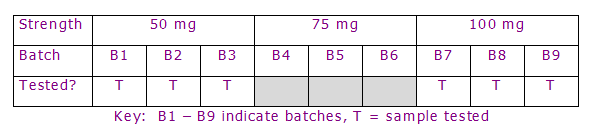
As it has been mentioned that the stability study must be conducted on three pilot scale batches, there is no need to perform analysis on all the three batches at every testing interval. One or two batches can be skipped at each testing interval.


Thursday, 10 March 2016

Emulsion and HLB value


Emulsion is a mixture of two immiscible liquids that is formed by using an emulsifying agent. Emulsions are usually of the following two types,

·         Oil in water: Oil is dispersed in water.
Water in oil: Water droplets, dispersed in oil.

Emulsifying agents are the agents that crate compatibility between immiscible liquids. As they contain an affinity for both the lipophilic (oil loving) and hydrophilic (water loving) mediums, they decrease the interfacial tention and disperse one phase in the other.

HLB system assigns the emulsifying agents with a unique numerical value, which range from 0 to 20. This value provide us an idea about the nature of the emulsifying agents.
Emulsifying agents, whose HLB value is,
less than 9, are more lipophilic
between 9 – 11, are intermediate
above 11, are more hydrophilic

For the development of emulsions, the choice of the suitable emulsifying agent is very important.
If we use a blend of more than one emulsifying agents, we can simply add their HLB values to find the net HLB value.

Example,
Find the HLB value of the blend of Tween 80 and Span 80, if their concentrations are 60% and 30% respectively.
Tween 80                            66% x 15 = 9.9                   (HLB of Tween 80 = 15)
Span 80                              30% x 4.3 = 1.29                (HLB of Span 80 = 4.3)
                                            Net HLB = 11.19

In some cases, the HLB value is calculated on the basis of the oil phase. For some oils, the HLB value that is required for their emulsification is known. In such cases, the HLB value is calculated as follow.

Example,
Calculate the required HLB value to emulsify a blend of Castor oil and Corn oil, if their quantities are 20% and 30% respectively, in the formulation. The HLB values that are required for the emulsification of Castor oil and Corn oil are 14 and 10 respectively.
Castor oil             20% x 14 = 2.8
Corn oil                 30% x 10 = 3
                Required HLB = 5.8
(This means an emulsifying agent or a blend of emulsifying agents that have an HLB value = 3, can emulsify this oil mixture)

During formulation development, we usually encounter such ingredients that have unknown required HLB value. For such materials, experiments are designed for the evaluation of the required HLB value. In these experiments, different formulations are prepared with different blends of Tween and Span grades. In this way, the blend of emulsifying agents that produce the most stable emulsion, is selected, and its HLB value is calculated.

Sometimes a need arise to blend two emulsifying agents to produce a desired HLB value. In such cases, the following formulas are utilized.
% of Emulsifier A = 100 (Required HLB – HLB of Emulsifier B)
                               HLB of Emulsifier A – HLB of Emulsifier B

% of Emulsifier B = 100 - % of Emulsifier A

Where,

HLB of Emulsifier A > HLB of Emulsifier B

Example,
Achieve the HLB value of 5.7, by using Glyceryl monostearate and PEG 400 monostearate, if their HLB values are 3.8 and 11.6 respectively.   
By using the above mentioned formula, we get,
% PEG 40 = 100 ( 5.7 – 3.8) = 24.36%
                          11.6 – 3.8

% Glyceryl monostearate = 100 – 24.36% = 75.64%

Tuesday, 8 March 2016

Osmotic pressure, Osmolality and Isotonicity


Osmotic pressure is the measure of the extent to which a solution can absorb water through a differentially permeable membrane. It is expressed as Osmoles, which is the number of moles of the solute that contribute to the osmotic pressure of the solution.
Osmotic pressure can either be represented by Osmolality, which is the number of osmoles per kilogram of the solution (osml/kg), or Osmolarity, which is the number of oslmoles of solute per liter of the solution (osml/L).

A solution is rendered isotonic if the osmole concentration of the solution is same as the cells or the biological fluids.

For Ophthalmic and Parenteral preparations, it is a crucial requirement to make the preparation isotonic.

Usually, Sodium Chloride Equivalent, method is utilized to adjust the osmolality of the solution.
According to this method, a solution containing 0.9% NaCl, which has an approximately 290 mosml/kg osmolality, is considered isotonic.
As there is a need to add buffers, antioxidants, cheleating agents, preservatives etc. to stabilize the formulation, which also contribute to the osmolality of the preparation, a calculated amount of Sodium Chloride or some other salt is added to attain the osmolality that is equivalent to 0.9% NaCl solution (290 mosm/kg). The sodium chloride equivalent method allows us to calculate the quantity of sodium chloride or some other suitable salt, which is required to produce an isotonic preparation.     

Check the following example to understand the use of this method.

Example,
Calculate the quantity of Sodium chloride that is required to create an isotonic tobramycin ophthalmic solution. If we use sodium sulphate instead of sodium chloride, how much it would be used to make the solution isotonic.

Tobramycin                            3 g
Boric acid                              5 g
Sodium borate                    1.1 g
Benzalkonium chloride        0.1 g
Disodium EDTA                 0.1 g
Sodium Chloride                      ?
Purified water Q.S           500 mL

The concentration of sodium chloride that is required to make 500 mL of water isotonic, can be calculated as,
500 x 0.009 = 4.5 g
Lets multiply the quantities of other ingredients with their Sodium chloride equivalent factors.
Tobramycin                        3 g x 0.07 = 0.21 g
Boric acid                             5 g x 0.52 = 2.6 g
Sodium borate                 1.1 g x 0.36 = 0.396 g
Benzalkonium chloride  0.1 g x 0.16 = 0.016 g
Disodium EDTA                 0.1 g x 0.24 = 0.024 g
                                         Total             = 3.246 g

Now we get the concentration of sodium chloride by subtracting this value from 4.5 g.
Sodium chloride = 4.5 – 3.246 = 1.25 g
If we need to use Sodium sulphate instead of sodium chloride, we divide this value with the sodium chloride equivalent factor of Sodium sulphate.
Sodium sulphate = 1.25 / 0.58 = 2.15 g

Wednesday, 2 March 2016

Buffer and Buffer Capacity

Buffers are formed by the combination of either a weak acid and the salt of its conjugate base or vice versa. They resist a change in pH against the addition of a small amount of acid or base.

The pH of a buffer is calculated by using the Henderson equation.

pH = pKa + log [Salt]
                         [Acid]
                                 or
pH = pKw - pKb + log [Base]
                                      [Salt]
 Where,
              pKa = Logarithmic dissociation constant of acid
              pKb= Logarithmic dissociation constant of base
              pKw= pKa x pKb
              [Acid]= Concentration of acid in moles
              [Salt]= Concentration of salt in moles

 Buffer capacity is the measure of the extent to which a buffer can resist a change in pH. It is represented by grams equivalent of the acid or base that is required to change the pH of one liter of the solution by one unit.

The Buffer capacity is usually calculated by the following equation,

Buffer capacity = 2.3 C   Ka [H3O+]
                                         ( Ka + [H3O+] )2

Where,
                       C = [Acid] + [Salt]
                       Ka= Dissociation constant of acid
                       [H3O+]= -log(-pH)
                       C = moles of salt / Liter + moles of acid / Liter 

Buffer and buffer capacity is a very useful tool for formulation development. Especially for the development of ophthalmic preparations, it is crucial to maintain the pH of the solution or suspension in the required range.

Example,
Use Borax and Boric acid to prepare the buffer for an ophthalmic solution. If 7 g of Boric acid is added in 500 mL solution, how much Sodium borate would be required to produce a buffer of 7.7 pH?. If pKa and Ka values of boric acid are 9.27 and 5.8x10⁻¹⁰ respectively, calculate the buffer capacity of this solution.

Lets use The Henderson equation,


pH = pKa + log [Salt]
                         [Acid]

By putting the values in this equation,

7.7 = 9.27 + log [Salt]
                                                                              [0.113]     (7g Boric acid = 0.113 moles)

Solving this equation gives,

                                                  [Salt] = 1.159 g of Borax     (0.003 moles of Borax = 1.159 g)

Calculate buffer capacity by using the following formula,

Buffer capacity = 2.3 C   Ka [H3O+]
                                         ( Ka + [H3O+] )2

Buffer capacity = 2.3 x 0.232 x  5.8x10-10 x 1.99x10-8
                                                  (5.8x10⁻¹⁰ + 1.99x10⁻⁸)2

Buffer capacity = 0.014

Note: For ophthalmic preparations, buffer capacity is usually adjusted between 0.01 - 0.1.